One minute you’re on a video call from the beach in Thailand, the next you’re trying to explain your symptoms to a doctor who doesn’t speak your language. This is when your health insurance becomes your most important travel companion.
However, if you fall ill in an unfamiliar country or your "worldwide" health plan excludes your current location, things can become complicated quickly.
Here’s how to find international health insurance that travels with you and what to look out for.
Understanding the cover you need
The first thing you need to know is that yes, you do need international health insurance as a digital nomad.
Why can't I use travel insurance or a local health plan?
Travel insurance or a local health plan typically won’t cut it – or at least won’t allow you to live a hassle-free nomadic lifestyle.
Limitations of local health plans
While many local health plans are comprehensive, they are geographically anchored: designed for those living and working in a single country. As a nomad, opting for a local health plan would leave you in a constant admin cycle where you’re researching, applying for, and cancelling plans every time you move.
This approach may leave you with gaps in coverage as you travel between locations and also requires you to navigate and understand new levels of coverage and the access you have to certain benefits and facilities. And if you have any pre-existing or chronic conditions, you'll need to disclose these every time, exposing you to different terms, waiting periods, or a choice between exclusions and premium loading every time you want to relocate.
Limitations of travel insurance
Travel insurance provides temporary protection for a single trip or multiple trips. It isn't a long-term healthcare solution. The medical scope of most travel insurance plans will cover unforeseen emergencies, such as accidents or sudden, acute illnesses, with the primary goal of stabilising you and returning you home for treatment.
Travel insurance generally won’t cover routine care, so you’ll have no access to check-ups, assistance for managing chronic conditions, or mental health support, leaving significant gaps in managing your overall health and well-being.
Check out the table below for a summary, or learn more in our comprehensive look at the difference between travel insurance and international health insurance.
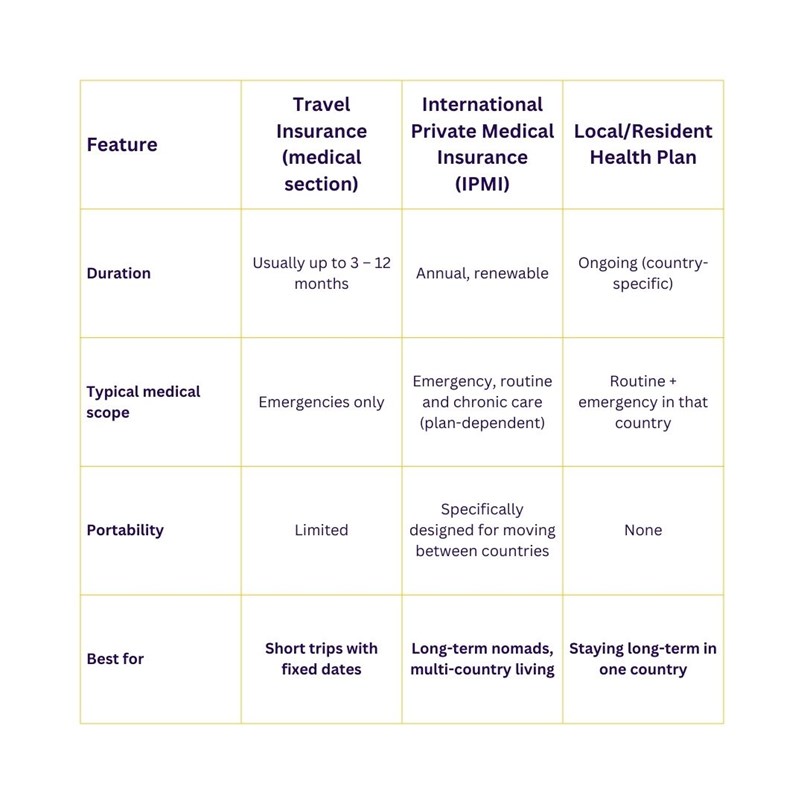
If you plan to live abroad indefinitely or frequently move between countries, IPMI will provide the continuity of coverage and peace of mind you need.
Your safety net: What every IPMI plan must include
Before you dive into nomad-specific features, ensure any plan you consider has a strong medical foundation that consists of the following:
- In-patient coverage. Look for plans with high benefit limits to protect you from high costs associated with hospital stays, surgeries, or other major treatments.
- Emergency medical evacuation, so you can be moved to the nearest suitable location for treatment if it isn’t available where you are.
- Out-patient coverage, so you can manage your day-to-day health and access whatever you need, from routine GP visits to specialist consultations and diagnostic checks, whenever you need to.
4 nomad essentials to look out for
By their very nature, IPMI plans are comprehensive and benefit-rich. While you must take the time to consider the different levels of broader coverage available from your various potential insurers, here are the four most vital aspects to review that will help you as a nomad.
1. Areas of cover, continuity and portability
There are three main things you should consider here:
- IPMI is priced by area, so look for providers and plans that enable you to tailor your cover for where you’re going, exclude any regions you don’t intend to visit, and check the depth of the medical network in your likely locations.
- Home country rules. Many plans offer home country coverage, but often only for emergencies or a limited number of days. If you're satisfied with using public healthcare at home, consider removing or limiting your home country coverage to reduce your premium.
- Portability without re-underwriting. Rather than choosing broad coverage from the start, save money by opting for more limited geographic coverage that you can change as you need to. Discuss with your insurer or an intermediary whether this is possible without re-underwriting, as your risk factors and the cost of coverage may change depending on your location.
2. Financial flexibility for your life on the move
As a digital nomad, you're likely going to be highly budget-conscious. Finding an IPMI provider that accepts a range of currencies means you'll be more likely to be able to pay for coverage in the local currency of your location, depending on how you pay for your plan. That means you can manage your finances more easily than having to factor in exchange rates and currency conversion fees when planning your health coverage and lifestyle.
You should also look for an insurer that offers a range of payment methods to offer you further flexibility, as well as the ability to pay claims in multiple currencies and to international bank accounts, while also outlining a clear timeline for efficient reimbursement.
3. Digital-first plans and digital tools
Having the ability to travel light is almost a prerequisite for life as a digital nomad, so the last thing you want to do is keep your IPMI paperwork and a physical membership card on hand at all times.
Most IPMI providers offer a broad suite of digital tools, with plans themselves being digital-first and your documents stored online should you ever need to consult them. When researching IPMI plans, consider which providers allow you to do most of what you'll need to do online, from managing your plan to making claims and contacting customer support.
4. 24/7 multilingual customer service support
And speaking of customer support!
One of the most significant reasons for opting for IPMI cover is the ability to seek treatment in your native language, so ensure you can also access customer support on the same terms whenever you need it.
Due to the needs of their members, IPMI providers typically have a more robust customer support infrastructure than local health or travel insurance providers, offering numerous means of contact.
Making the most of your coverage as a digital nomad
Ultimately, finding the right IPMI means that when you're explaining your symptoms to a doctor in an unfamiliar location, your only concern will be getting better. Not how you'll pay for it or if you even have cover.
Remember to read all brochures and wording carefully, ask direct questions to insurers or brokers, and ensure your IPMI plan meets all your needs.
That way, you can ensure your coverage is as flexible as your lifestyle.
Explore our comprehensive range of private health plans.